Table of contents
Clear-cut patches and freshly felled trunks can look like the end of a story, yet in many forests it is the start of an ecological relay, shaped by soil microbes, light, rainfall patterns and the choices people make in the weeks after machines leave. Across Europe and North America, post-removal landscapes are increasingly scrutinized because heatwaves, pests and wildfires are testing recovery; the same intervention can regenerate a resilient stand or lock a site into decline, and the difference often comes down to what happens next.
The first 72 hours decide a lot
What you do immediately after felling can echo for decades. In the first days, the site’s biggest risk is not “lack of trees” but soil damage, because the living engine of recovery sits underground. Heavy equipment can compact the upper 10 to 30 centimeters, reducing pore space that stores air and water, and studies in temperate forests routinely find that severe compaction cuts infiltration, slows root penetration and can depress growth for years; in practical terms, a compacted skid trail becomes a long, dry strip where seedlings struggle and runoff concentrates. The second immediate issue is erosion, especially on slopes and in riparian zones, where disturbed soil can wash into streams, raising turbidity and smothering fish spawning gravels, and regulators in many jurisdictions now focus on “sediment pulses” as an early, measurable harm of poor post-harvest practice.
Then there is what remains on the ground. “Slash” piles, branches and tops, are often seen as debris, yet they can protect soil from sun and heavy rain, buffer temperature swings and provide carbon that feeds fungi and bacteria; at the same time, excessive slash in dry regions can elevate fire risk and can complicate replanting. That is why foresters increasingly aim for balance, keeping some woody material dispersed while avoiding continuous fuel beds, and why timing matters: if a site will be replanted, planting windows can be narrow, particularly for bare-root stock that must go in while soils are moist and cool. In many temperate regions, survival rates are highest when seedlings are planted in late winter to spring, before the hottest months; delays can turn a “routine” recovery into an expensive replanting cycle.
Sunlight floods in, and rules change
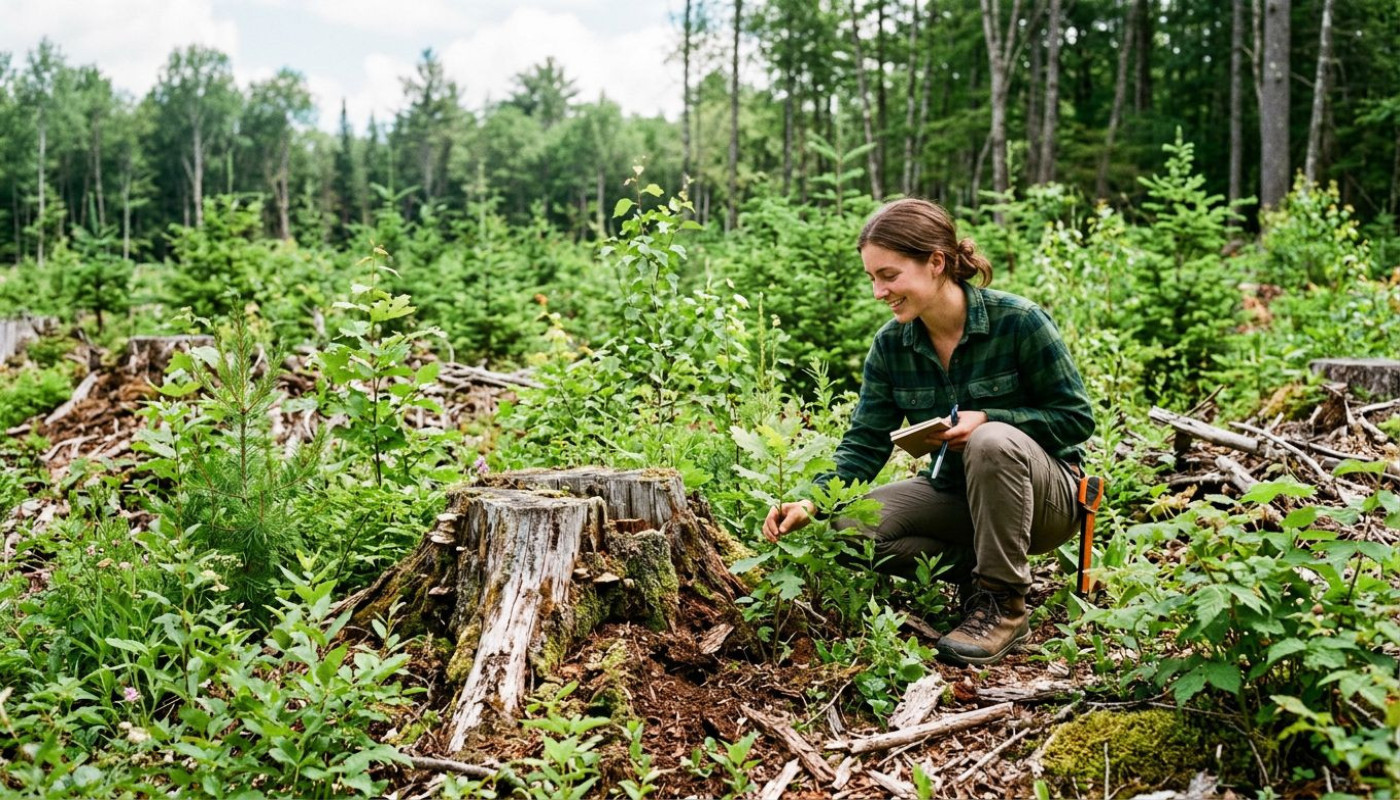
After canopy removal, the forest becomes a different climate. Light levels at the ground can jump dramatically, wind speeds rise, humidity drops and soils can warm by several degrees, conditions that favor fast-growing pioneer plants but can stress shade-adapted species. Ecologists describe this as a shift in the “microclimate,” and it drives the first visible wave of recovery: grasses, brambles, fireweed and other early colonizers race to occupy space, stabilizing soil and providing nectar and cover for insects and birds. In many places that green flush is a good sign, yet it is not automatically a path back to a mature forest, because competition can become fierce, and some invasive plants exploit exactly these bright, disturbed conditions, forming dense mats that block tree seedlings.
The wildlife response is equally dynamic. Open habitats can briefly benefit species that avoid closed forests, such as certain ground-nesting birds, butterflies and browsing ungulates, while interior-forest specialists may retreat until canopy cover returns. Deadwood, if left, can become critical: snags and downed logs are nursery sites for mosses, fungi and beetles, and feeding stations for woodpeckers, and in some ecosystems they are linked to higher biodiversity during regeneration. But there is a trade-off that managers cannot ignore; in drought-prone landscapes, retaining too much standing deadwood can increase hazards along trails and roads, and can add to fuel loads. The “right” mix depends on local fire regimes, public safety constraints and conservation goals, which is why blanket prescriptions tend to fail when applied across regions with different climates.
Regrowth isn’t automatic, it’s engineered
Natural regeneration can be powerful, but it is not guaranteed. Seed availability is the first limiting factor: if mature seed trees remain nearby, wind and animals can repopulate a cut area surprisingly quickly, yet where removals are large, or where pests and storms have reduced surrounding stands, seed rain can be too thin to restock the site. Foresters often refer to “stocking,” the density of desirable young trees per hectare, and many guidelines in managed forests specify minimum stocking targets within a few years; when those targets are not met, replanting or enrichment planting becomes the practical route. Species choice is also more complicated than it sounds, because climate trends are shifting what “belongs” where, and agencies in several countries now discuss assisted migration, moving seed sources slightly northward or upslope to match expected temperatures decades ahead.
Planting, however, is only the beginning. Early survival hinges on moisture, browsing pressure and competition, and those pressures are intensifying. In many regions, deer densities have risen over recent decades, and heavy browsing can remove leaders and permanently deform young conifers and hardwoods, forcing landowners into fencing, tree shelters or targeted population control. Competing vegetation can be managed mechanically or, where permitted, chemically, but each approach carries costs and controversies, and the public debate is increasingly about trade-offs rather than absolutes. In this context, homeowners and small land managers often turn to specialist guidance to avoid expensive missteps, from choosing a planting mix to deciding how much woody residue to retain, and the most useful resources are those that explain timelines, risks and maintenance in plain language; for practical orientation on what comes next and how recovery is typically managed, readers can visit site for an overview of post-removal steps and planning considerations.
How long until it feels like a forest?
The honest answer is: it depends on what you mean by “forest.” Visually, a cut area can look green again within one to three growing seasons as herbs and shrubs surge, and in productive temperate zones, young trees can reach head height in five to ten years, especially if planted and protected. But the return of a closed canopy often takes 15 to 30 years, while features people associate with mature woods, layered structure, large-diameter trees, stable shade and deep deadwood networks, can take many decades or longer. Ecologists sometimes use the term “ecological memory” to describe the legacies that speed recovery, such as intact soil structure, surviving roots, nearby seed sources and remnant patches; where those legacies are erased by repeated disturbance, recovery slows, and the site can shift toward a different vegetation state.
Climate extremes are now the wild card. Heatwaves can scorch seedlings, late frosts can kill new shoots, and longer fire seasons can turn young stands into fuel ladders, a concern highlighted in multiple wildfire-prone regions where dense regeneration has contributed to high-intensity burns. Pest dynamics matter too, because stressed young trees are often more vulnerable, and outbreaks can reshape species composition early in succession. That is why monitoring is no longer a formality; it is the way managers decide whether to thin overcrowded saplings, replant gaps, control invasives or adjust species mixes. A resilient recovery is rarely a single action, it is a sequence of small decisions, made at the right moments, that keep soil functioning, water clean and the next generation of trees on track.
Planning your next steps, not just cleanup
Budgeting after removal is easier when it is staged. Immediate costs tend to cluster around site safety, stump decisions, debris handling and erosion control, while medium-term costs are driven by planting, protection against browsing and follow-up maintenance in years two to five, when competition can overwhelm seedlings. Homeowners often underestimate the price of “doing nothing” on a disturbed site, because unmanaged invasives, drainage issues or repeated replanting attempts can quickly exceed the cost of a well-planned first intervention. Where grants or public programs exist, they may support reforestation, riparian buffers or hazard mitigation, but they typically require documentation, species standards and deadlines; checking eligibility early can unlock funding that is unavailable once a site has been left to degrade.
Scheduling is just as important as money. The best contractors and planting crews book months ahead, and optimal planting windows can be short, so early reservations reduce rushed decisions. A realistic plan sets milestones, erosion control first, then replanting or regeneration checks, then protection and monitoring, and it defines what success looks like, whether that is biodiversity, timber value, shade for a stream or simply a stable, healthy green cover. Tree removal ends a chapter, but recovery is the part that determines whether the landscape rebounds, and with the climate growing less predictable, that next chapter deserves as much attention as the cut itself.
On the same subject

The Role Of Hashtags In Navigating Social Media Content

Comprehensive Guide To AI Video Generation For Marketing Professionals

Exploring The Impact Of AI Chatbots On Modern Customer Service Strategies

Enhancing Human Perception: The Science Behind Photorealistic Eye Art

Exploring the Science Behind the Algorithms of Casino & Betting Bonus Codes

Exploring the Latest Trends in Exhibition Stand Design and Construction
